Research the property you are considering
For a home in Gary, Indiana or land around Gary City, Texas, begin with the exact address and parcel identifier. Match the property record, establish the responsible authorities, then investigate its condition, services and your proposed use. A listing price or a town name is not enough information to compare two properties meaningfully.
This is a research guide, not a collection of invented listings or a recommendation to buy, borrow or invest. It helps you prepare questions and organise evidence for the professionals and offices responsible for an actual transaction. Sources reviewed . Terms, charges and individual property conditions need their own current evidence.
| Research area | Property-record starting point | Further authority routing |
|---|---|---|
| Gary, Indiana | Lake County parcel, tax and recorded-document links | Gary Zoning and Building Department for city development enquiries. |
| Gary City, Texas area | Panola County Appraisal District | Panola County offices and the applicable municipality or service authority. |
Write the intended use before researching permission
Describe what you want to do in ordinary language: occupy an existing home, renovate it, build on land, add a structure, rent space or run a particular activity. Include the scale and any important physical change. “Is this allowed?” is hard to answer without that description. The same parcel may raise different questions for different proposals, so make your proposal part of the research file from the beginning.
Make sure every document concerns the same property
Match the address, parcel and included land
A listing can describe a building, several lots or only part of a larger tract. Ask for the parcel identifiers and a clear description of what is included. Compare these with the county record and the material supplied for the transaction. If a garage, adjoining lot or access strip matters to your plan, identify it explicitly rather than assuming it is included because it appears in a photograph.
For Indiana, the county's official search menu separates assessor, tax and recorded-document resources. For Texas, use the appraisal search to identify the record, then follow the county's appropriate records route for documentary questions. Keep the outputs distinct. A tax-account screen, a deed and an inspection report serve different purposes even when all three show the same street address.
Keep a concise property cover sheet
Record the original listing link, supplied address, parcel identifiers, included structures, source dates and contact person. Add a column for unresolved differences: an extra lot, a changed street name or a building described differently in another record. Do not correct those differences silently. Ask the relevant person to explain them and retain the response with the file.
If a map pin falls in the wrong place, return to the identifying record. A pin is a navigation aid, not a description of the land conveyed. Our maps and ZIP-code guide explains how to separate a mailing address, parcel map and physical entrance. Settle that identity before spending time on comparisons which might otherwise concern the wrong property.
Establish which office answers each question
In Gary, Indiana
The city zoning page provides development-map and verification routes. The Building Department describes its permit and inspection functions. Use those sources to ask how your specific proposal should be reviewed. Keep land-use permission and the building-work process as separate questions; a general conversation about a site does not complete either process.
Send the address, parcel identifier and short proposal together. Ask which record describes the existing classification, which office must review the proposed work and what sequence applies. If you are considering a use that depends on an approval, obtain the appropriate written evidence before treating it as an established feature of the property.
In the Gary City, Texas area
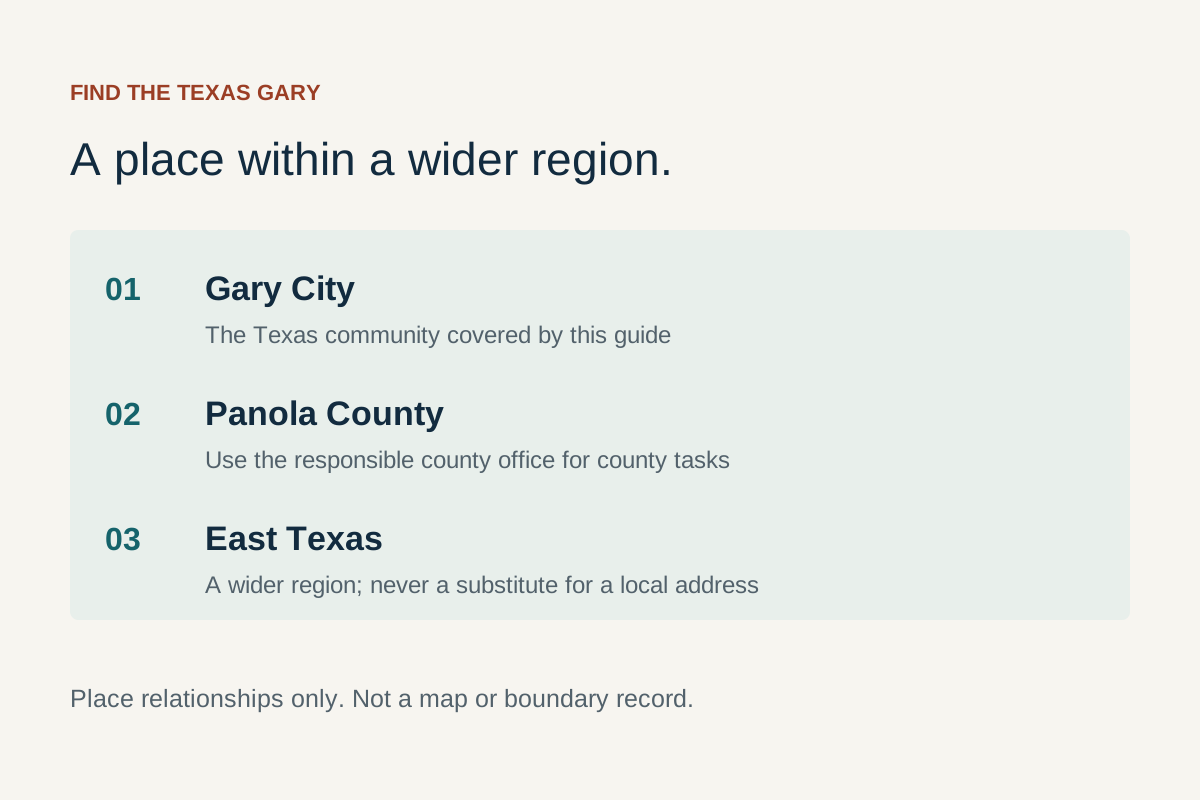
Use the municipality and Panola County's directory to identify the responsible office for the exact tract. A Gary mailing address should not be used to infer city limits or the absence of a requirement. Ask which authority handles addressing, access, wastewater or development questions for that location and proposal.
Record the department's name and the scope of its answer. “We do not handle that” is a referral point, not an approval. Ask where the question belongs next. This is particularly helpful when a project crosses several responsibilities: land records identify the property, a permitting authority considers a proposal and a provider considers a connection. No one answer should be stretched to cover the other two.
Separate appearance from physical condition
Use the viewing to collect questions
Before a viewing, list the systems and features that matter to your intended use. During the visit, record what you can actually observe and what needs assessment. A recently decorated room, a new appliance or a wide-angle photograph does not answer questions about underlying condition. Take notes with permission and identify the room or structure so a later question is unambiguous.
For Texas inspection research, the Texas Real Estate Commission's consumer inspection guidance explains the role of its standards and required reporting. Use the regulator's current information to understand the service being offered. Ask any professional what is included, what cannot be inspected and what additional specialist work might be needed. A verbal walk-through and a written inspection scope should not be treated as equivalent products.
Turn findings into follow-up tasks
Read the whole report, including limits and items not inspected. Create a short action list: finding, why it matters to your plan, person to consult and evidence needed. A report can identify a concern without pricing the remedy. A repair estimate can price a scope without confirming that the scope resolves every underlying issue. Keep the roles clear when assembling the next steps.
Ask about access for any further assessment before arranging it. If utilities are off or an area is inaccessible, record that limitation rather than assuming a system passed. Compare answers for the specific property; a general statement about houses of the same age does not establish the condition of this building.
Investigate older buildings and planned alterations
Connect records with the work you intend
Ask for the available history of additions, major repairs and changes of use. Compare that account with the visible building and relevant official records. If a space is described as a bedroom, apartment, finished area or workspace, ask what supports that description and whether it matches your intended use. Avoid assuming that an advertised room label settles the question.
For Gary, Indiana alterations, use the Building Department to ask about the work proposed and the evidence required. Do not treat an old permit as a warranty of the building's current condition, or the absence of a search result as definitive proof that no record exists. Ask how older records can be checked and which inspections or approvals apply to the new work.
Use the appropriate lead-paint information
The EPA's disclosure guidance describes the federal rule concerning known lead-based-paint information for most housing built before 1978, including exceptions. If that period is relevant, obtain the applicable disclosures and ask a qualified professional about assessment and any proposed disturbance of painted surfaces. A fresh finish or an unknown construction year does not answer those questions.
Keep health assessment, renovation planning and transaction documents in their appropriate roles. This guide does not diagnose a hazard in a particular home. The practical step is to identify what is known, what documentation exists and which assessment is needed before work. That produces a more useful project file than assigning a property a risk label from its age alone.
Check water, wastewater and access for the actual site
Identify the existing arrangements
Ask how the property receives water and handles wastewater, which organisation is responsible and what documentation is available. Confirm whether the arrangement serves the entire property included in the transaction or only an existing structure. A tap visible on the site does not explain capacity, condition or the terms for adding another building.
In Texas, TCEQ's on-site sewage facility guidance explains the role of the local permitting authority and site evaluation. Use it to find the right authority and ask which requirements apply. Do not reduce the process to a rule of thumb about acreage: the state's guidance includes conditions and exceptions which need the site's actual circumstances.
Ask about the proposed use, not just the current use
An existing service arrangement may have been designed for a different demand. Describe the number and type of structures you propose, any change in activity and the intended timetable. Ask for connection conditions, assessment needs and costs from the responsible provider or authority. Keep estimates dated and identify what is excluded, such as work on the property rather than at the road.
For access, distinguish the driveway you see from the documented right and practical ability to reach the property. Ask the appropriate professional to review access documents where they matter to the transaction. Confirm the physical route for visits with the owner or representative. Never test an uncertain route by crossing a neighbouring tract without permission.
For a larger tract, ask how maintenance responsibilities are described. A usable route on the day of a viewing does not explain who maintains it or how future work is arranged. Record the answer alongside the access documentation so practical and documentary questions remain connected.
Verify utilities and internet before comparing running costs
Ask each provider about the same address
Create one service worksheet for electricity, water, wastewater, waste collection and internet. Record the provider, whether service is active, the steps to establish an account, any installation work and the quotation date. Ask which charges are one-time and which recur. If an answer depends on a site visit or survey, keep it conditional rather than converting it into a fixed cost.
The FCC's broadband availability guidance explains that map information is provider-reported availability, not a measurement of affordability or performance. Use the map to identify leads, then request address-specific ordering information. Ask about installation, upload and download needs, equipment, data terms and the total quoted charge. A provider's name on a regional map is not a completed service order.
Compare service quality against your actual routine
If working from home, describe the tasks the connection must support rather than relying only on a headline speed. Ask how installation timing fits the move, what equipment is supplied and what happens if an installation assessment changes the quote. Keep a workable move-in plan if the connection will not be ready on the first day.
For other services, clarify who arranges collection or maintenance and whether any container, meter or account transfers with the property. Do not assume the previous occupier's arrangement becomes yours automatically. This worksheet is equally useful for an Indiana house and Texas land, while the actual providers and conditions remain specific to each address.
Investigate drainage and flood information as a separate task
Start with the identified property, not a citywide label
Start with FEMA's Map Service Center for official flood-map products. FEMA's Flood Insurance Study guidance explains how to find the applicable products and distinguish effective information from preliminary or historical material. For a particular property, ask the responsible local authority about questions affecting the proposed project. Record the map date, location and any relevant amendments rather than saving only an unexplained colour.
Map research and site drainage questions complement one another. Ask about documented past water entry, drainage work and the condition of relevant systems. During a visit, note observations to discuss with a qualified person instead of diagnosing their cause yourself. A dry visit gives information about that visit; it does not reconstruct the site's behaviour during a different event.
Keep insurance and project requirements distinct
Ask an insurer or lender about the requirements and terms for the actual property and transaction. Ask the permitting authority about development requirements. Those are different enquiries, and neither should be answered by a third-party listing's brief risk label. Request the source or document behind any determination you need to rely on.
No property-level flood determination, premium or probability is supplied here. The useful output is a set of dated records and specific follow-up questions. If an official map service is temporarily unavailable, record the gap and return to it; a failed page load should not be treated as evidence of low risk.
Ask what rights, restrictions and responsibilities are included
Separate the physical land from the legal interests
Ask the appropriate transaction professional to explain the description of the property, recorded interests, access arrangements and restrictions relevant to the proposed use. Keep unfamiliar terms as questions rather than guessing their meaning. A listing's short description is not a substitute for the documents governing an actual transaction.
For Texas land with oil-and-gas questions, the Railroad Commission's oil-and-gas FAQ is a regulatory starting point. The rights included in a sale and the interpretation of title documents require the appropriate property-specific review. Do not assume that buying a surface tract answers every question about other interests or historic agreements.
List the obligations you need explained
Ask about shared access, maintenance arrangements, association documents where applicable, recorded restrictions and any outstanding matters identified in the transaction review. For each item, record who supplied the information and which document supports it. If a promised use depends on a future consent, keep that dependency visible.
This step is about preparing an informed discussion, not reaching a legal conclusion from an online search. Avoid using a county map, a neighbouring owner's experience or a regulator's general FAQ to decide what an individual document means. A precise question with the relevant page attached will help your adviser answer the issue efficiently.
Build a cost file with dates, scope and exclusions
Use categories instead of a guessed affordability score
Keep the asking price separate from transaction costs, repairs, connections, recurring costs and the costs of your proposed work. Populate each line with actual evidence when available. A quote should identify the property, scope, date, conditions and validity period. If the figure is only a preliminary allowance, label it that way.
| Category | Evidence to request | Important distinction |
|---|---|---|
| Acquisition and transaction | Current agreed terms and professional explanations. | Asking price versus final terms and separate charges. |
| Condition and repairs | Inspection findings and scoped estimates. | Observed issue versus priced remedy. |
| Services and connections | Address-specific provider quotations. | Installation work versus recurring bills. |
| Taxes and insurance | Relevant account records and current quotations. | Previous occupier's amount versus your circumstances. |
| Proposed alterations | Design scope, authority response and contractor estimate. | Desired improvement versus an approved, priced project. |
| Travel and routine | Your actual work, school and service journeys. | A map distance versus a workable weekly pattern. |
Where you total costs, keep one-time and recurring amounts separate and use the same period for recurring comparisons. Explain which lines remain unknown. A neat total that omits major unresolved items is less useful than an incomplete worksheet that shows exactly what still needs a quote.
This guide does not supply borrowing limits, future returns or a recommended offer. Discuss financing and transaction decisions with the relevant qualified professionals using your actual circumstances. The worksheet's purpose is to improve the evidence going into that discussion.
Test the home against an ordinary week
Map the recurring journeys
Write down work, school, shopping, appointments and the visits you make regularly. For Gary, Indiana, use the transport guide if a South Shore or bus connection matters. For the Texas area, keep destinations in Gary, Carthage and elsewhere clearly labelled rather than assuming all services are in the city itself.
Choose the day and time relevant to your routine, then check the actual transport or route. A weekend viewing may not represent a weekday schedule. Ask about parking or visitor arrangements at the destination rather than assuming a map pin includes them. If someone in the household needs an accessible route, examine the whole journey from the property to the usable entrance.
Confirm schools through the organisation
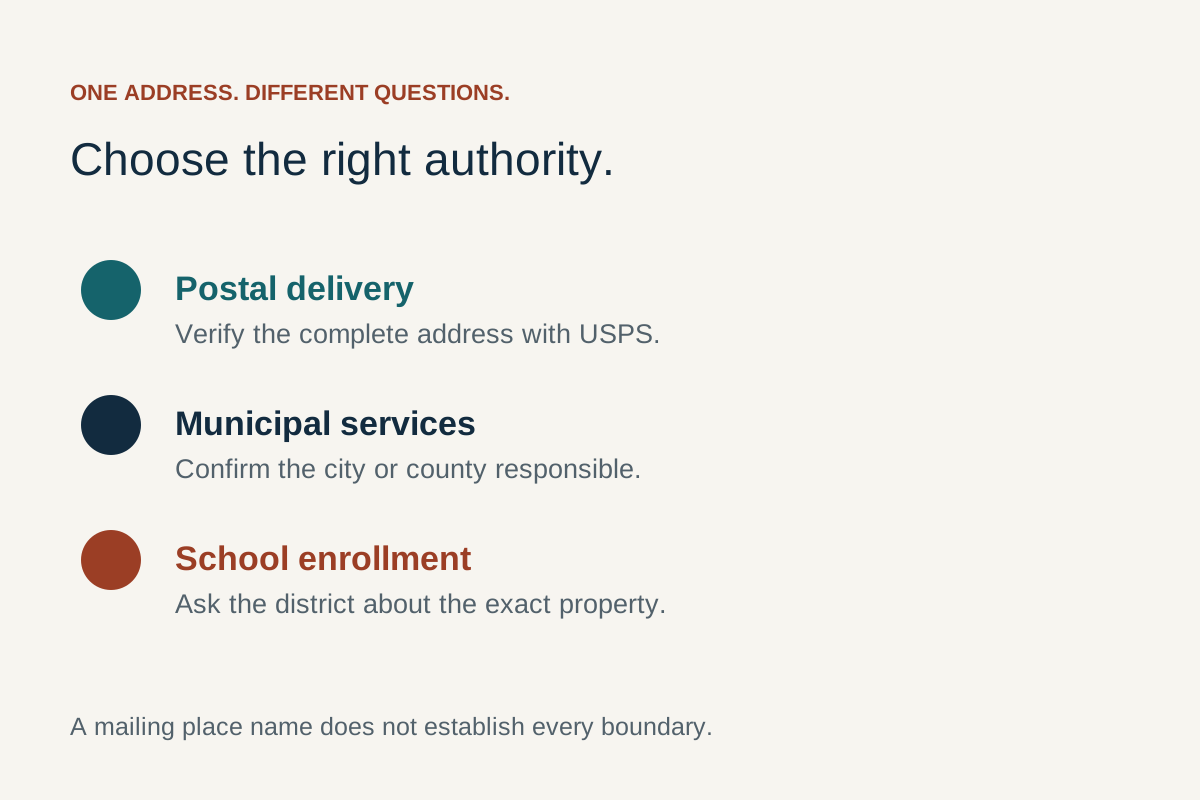
Use Gary Community School Corporation or Gary ISD as the relevant starting route, then confirm the address and student's circumstances with the responsible school organisation. A school name in a property advertisement is a lead to verify, not an enrolment decision.
Also consider the practical questions a viewing does not answer: deliveries, maintenance access, storage, shared spaces, visitors and seasonal changes to the way you use the property. Record requirements as your own priorities rather than ranking neighbourhoods with unsupported scores. This makes the comparison specific to your household and avoids turning reputation or appearance into a claim about every nearby property.
Use a staged workflow for three common searches
An existing Indiana home
- Match the included parcels and the current listing description.
- Review the relevant county records, keeping assessment and tax information separate.
- Prepare a physical-condition enquiry and arrange the appropriate assessment.
- Describe any intended alterations to the city departments responsible for review.
- Confirm services, schools and the regular journeys important to the household.
- Bring the resulting evidence and unresolved questions to the transaction professionals before making a dependent commitment.
The sequence reduces rework: a proposed use that changes the scope of the search is identified before you treat a renovation estimate as a complete budget. It does not set transaction deadlines or replace the terms of an actual agreement.
Texas land for a future project
- Obtain the tract identifiers and confirm exactly what land is included.
- Clarify access documents and the physical entrance.
- Identify the authority responsible for the intended use and address.
- Investigate water, wastewater, electricity and internet for the proposed development.
- Arrange the required site-specific assessment and document review with appropriate professionals.
- Compare priced, supported possibilities rather than assuming a vacant tract is ready for the project.
Do not use acreage alone as a readiness measure. The useful question is whether the particular project can be supported on the particular site, with the necessary rights, access, services and review.
A rental or temporary move
Verify the actual unit, the person authorised to offer it and the written terms. Confirm what utilities and maintenance are included, the move-in arrangements and the process for reporting problems. Keep any payment or identity-document request within a verified relationship. Our guide does not advertise units or collect deposits; use the actual provider's process only after verifying the offering.
Choose help by the question that needs answering
The Texas Real Estate Commission's consumer guide explains the roles of regulated real-estate professionals and its licence-lookup resource. Use the appropriate regulator for the state and profession involved. A professional's title alone does not tell you the scope of the service you are buying, whether they represent you or what the fee covers.
Ask about scope, representation and deliverables
Before engaging a professional, describe the property and question, ask what they will provide and clarify exclusions. Request an explanation of any referral relationship or potential conflict relevant to the task. A survey, title review, inspection, appraisal and contractor estimate are distinct deliverables; choose the service that answers the unresolved question rather than treating one as a substitute for all the others.
Keep appointments and document requests organised around dependencies. If an estimate depends on an inspection finding, send the relevant finding with permission. If a project depends on an authority response, retain that response with the proposed scope. This helps prevent different professionals from working from incompatible assumptions about the same property.
Make unresolved issues visible
Use three statuses: evidence obtained, further explanation needed and not yet investigated. Add the next owner and next action to every open item. Avoid a generic “checked” mark where the result was only a website search. Your final decision file should show what supports the decision and which uncertainties remain, without pretending that every possible question has been eliminated.
Prepare the handover and the first ordinary month
Turn transaction answers into practical instructions
Once an actual agreement is being handled by the appropriate professionals, build a separate handover list. Record the agreed possession arrangements, who will provide access and which documents or items are expected. Keep this list aligned with the written terms rather than adding assumptions from a viewing conversation. Any disagreement about what the agreement requires belongs with the professional advising you on it.
For an occupied home, ask how keys, entry devices, equipment instructions and relevant maintenance records will be transferred. Identify which items remain and which do not. For a rental, record the inventory and condition process required by the provider and the route for reporting a problem. For land, clarify entrance instructions and any agreed handover of records relating to the tract or existing infrastructure.
Arrange accounts using verified provider information
Use the service worksheet to schedule the necessary account changes or installations. Confirm the property and unit on each request, then retain the provider's acknowledgement. If a service depends on access to the site, agree how that access will be arranged. Ask which account number or reference should be used for a follow-up, without copying the previous occupier's private account details into your own file.
Keep the first month realistic. A contractor visit, internet installation and household move may require the same driveway or someone to be present. Put those commitments on one calendar so a scheduling clash is visible. Record which dates are confirmed and which are provisional. This avoids treating an estimate of completion as a booked appointment.
Document the condition at the relevant point
Follow the agreed inspection or inventory process, keeping dated notes and permitted photographs associated with the correct room, structure or area. Distinguish a condition you observed from a conclusion about its cause. If something differs from the agreed terms or supplied information, raise the specific issue through the appropriate channel instead of assuming that an informal note resolves it.
For ongoing maintenance, assemble the useful operational information: provider contacts, equipment manuals, assessment reports, warranties where supplied and the schedule of work you have actually arranged. Keep historic reports dated. A previous owner's maintenance invoice may be helpful background, but it should not be rewritten as work you commissioned or a guarantee of future performance.
Keep a short unresolved-items list after arrival
Some practical questions become clearer only when you begin using a property. Record them with the relevant source: an account still awaiting activation, a document requested from an office or a service appointment not yet completed. Give each item a next action and contact route. This keeps routine follow-up separate from the much larger transaction file.
Finish by updating the household's reliable addresses and emergency contact information through the organisations concerned. Retain the confirmed postal format separately from delivery and visitor instructions. The goal is a usable record of the property you now occupy or manage, with clear responsibilities, rather than a folder of undated screenshots collected during the search.
Give vacant land an operating plan as well as a project plan
Ask what happens before the future building exists
If your intended project is several stages away, describe how the land will be managed in the meantime. Identify permitted access, the person responsible for checking the site and the work you actually expect to arrange. Ask the appropriate authority about requirements relevant to that land and work; do not copy a maintenance assumption from a different tract.
Keep any vegetation, drainage, fencing or access work within a defined scope reviewed by the appropriate person. Ask what equipment can reach the site and what permissions or specialist input the proposed work needs. An estimate for clearing part of a tract is not automatically an estimate for preparing the complete site for construction.
Connect maintenance to the project sequence
Record which work supports the eventual project and which work simply maintains the present property. This prevents paying for a temporary arrangement while assuming it resolves a later design question. Keep the project timetable conditional on the outstanding evidence, approvals and service arrangements. A practical management plan makes the period between acquisition and the proposed use visible in both the responsibilities file and the cost file.
Questions about Gary homes and land
Does GaryCity publish current homes for sale?
This page provides a research workflow and official-source routes. It does not claim to operate a verified listing feed. For an actual offering, check its current status, included land, representative and terms directly. An old search result or archive is not evidence that a property remains available.
Can I use an appraisal value as the amount I should offer?
An assessment or appraisal record has a particular purpose and date. Keep it separate from asking price, transaction evidence and the advice of the professional handling a valuation question. This guide does not turn any one record into a recommended offer or borrowing decision.
Does a Gary, Texas mailing address prove the land is inside the city?
No. Confirm the jurisdiction for the exact tract and task. Postal recognition, municipal limits, school attendance and service coverage are separate questions. The address guide provides a method for keeping those records distinct.
Can an empty lot be assumed suitable for a house?
Start with the intended project, then investigate access, services, site conditions, relevant restrictions and the responsible authority's requirements. The absence of an existing structure does not answer those questions. Obtain the property-specific evidence before treating the project as feasible.
What should I do when two sources disagree?
Check that they concern the same parcel, date and question. Keep both records and send the specific discrepancy to the appropriate office or professional. A difference between a mailing label and a land-use record may reflect different purposes rather than a simple error.
Where can I find the relevant offices?
Use local resources for city, county, school and service routing. Bring the parcel identifier, address and proposed task. That information helps an office answer a concrete question and reduces the chance of being referred repeatedly between organisations.